Upload your notes, a photo of your textbook or the chapter PDF and pick what you need: a summary, a mind map, a quiz to check what you know, or a step-by-step solution to a problem. Below is exactly what each tool produced from a real high school biology text.
No account? The free tools (math calculators and word counter) work without signing up.
Real example: photosynthesis, from a PDF to a quiz
On September 23, 2026 we ran the same PDF through four PhotoExamAI tools and copied what they returned, unedited. The PDF is a 1,005-word excerpt (3 pages) from the Wikipedia article “Photosynthesis” (Wikipedia contributors, CC BY-SA 4.0): chloroplasts and pigments, the light-dependent reactions and the Calvin cycle. Download the PDF and try it yourself.
Photosynthesis is in every high school biology course (NGSS HS-LS1-5) and is topic 3.4 of AP Biology, Unit 3. This excerpt goes into the steps of both stages, which is AP level: the NGSS standard leaves specific biochemical steps out of assessment. We sent the four requests at the same time, and the times below are how long each one took.
1 · Summary · 71 s
The summary it generated
Heads up: it came out longer than the source (1,823 words vs. 1,005). It explains instead of cutting, and adds textbook material that isn’t in the excerpt, such as the full non-cyclic electron path from water to NADP⁺ (it labels that part “Implied”) and the fact that cyclic flow tops up ATP. We checked it and it is correct. If you need something short to memorize, the mind map below works better.
Below is a structured, detailed summary of the excerpt, with explanations of key terms and processes to make the material clear and coherent as a whole.
1. Overall Purpose and Nature of Photosynthesis
Basic idea: Photosynthesis is a biological process in which light energy is captured and converted into chemical energy, ultimately stored in carbohydrates (sugars).
Core chemical change: Carbon dioxide (CO₂) from the atmosphere is converted into sugars in a process called carbon fixation. This is:
A redox reaction (involves transfer of electrons).
Endothermic (requires an input of energy), which is supplied by sunlight.
Relationship to cellular respiration:
Photosynthesis and cellular respiration are essentially opposite in direction:
Photosynthesis: reduces CO₂ to carbohydrates, storing energy.
Respiration: oxidizes carbohydrates (and also amino acids and fatty acids) back to CO₂ and water, releasing energy to power metabolism.
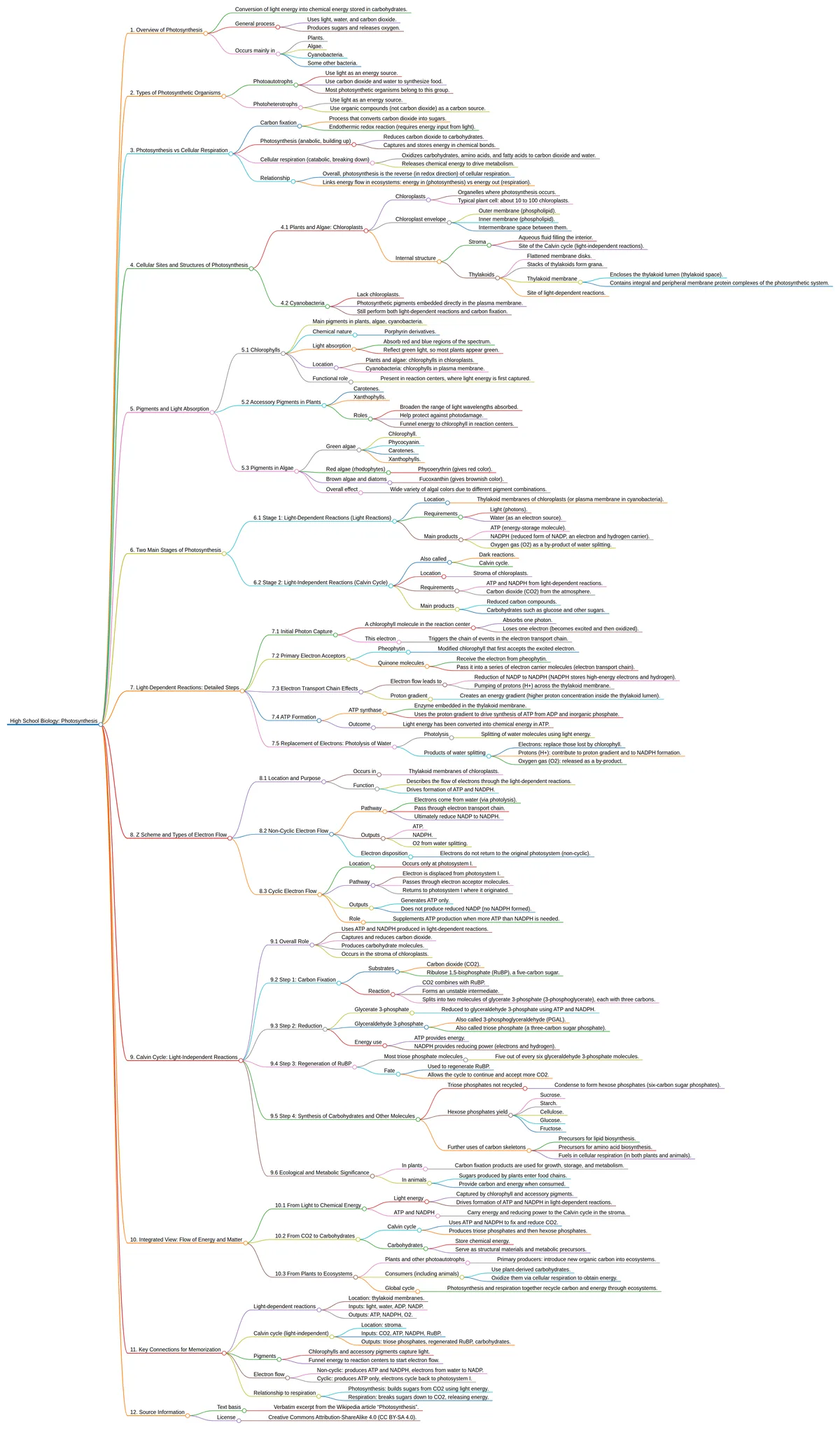
The tool returns the outline as a mind map you can expand branch by branch. The image was rendered from the real output with the same library the app uses (markmap). The last branch, “Source Information”, comes from the license footer of the PDF.
One mistake to watch for: under “Pigments in Algae” it lists phycocyanin for green algae. That error is in the Wikipedia text we used, and the summary and the notes repeat it too. Phycocyanin is a pigment of cyanobacteria and red algae.
A mix of multiple choice, true/false, fill in the blank, matching, ordering and short answer. All of them can be answered from the PDF, and in the app you answer them and get graded right away. One of them came out broken: in the matching question (number 6) the tool left the answer options as question marks. We show it as it came out; the correct pairs are in its answer.
1. In plants, where do the light-dependent reactions of photosynthesis specifically take place?
In the thylakoid membranes of the chloroplasts
In the stroma of the chloroplasts
In the cytoplasm
In the mitochondrial inner membrane
Show answer
In the thylakoid membranes of the chloroplasts
2. Which pair of molecules is produced by the light-dependent reactions and then used in the Calvin cycle?
ATP and NADPH
NADH and ATP
Glucose and oxygen
Carbon dioxide and water
Show answer
ATP and NADPH
3. The light-independent reactions of photosynthesis in plants, algae, and cyanobacteria are collectively known as the _____ cycle.
Show answer
Calvin
4. Photoheterotrophs use light as an energy source but obtain their carbon from organic compounds instead of carbon dioxide.
True
False
Show answer
True
5. During carbon fixation in the Calvin cycle, carbon dioxide first combines with which five-carbon sugar?
Ribulose 1,5-bisphosphate (RuBP)
Glucose
Ribose
Fructose 1,6-bisphosphate
Show answer
Ribulose 1,5-bisphosphate (RuBP)
6. Match each chloroplast structure with its description.
Match: Stroma, Thylakoid, Thylakoid lumen (space), Thylakoid membrane. The tool left all four right-hand options as “?”, so this question can’t be answered in the app.
Show answer
Stroma → Aqueous fluid inside the chloroplast surrounding the thylakoids · Thylakoid → Flattened disk-like sac that can be stacked into grana · Thylakoid lumen (space) → Enclosed internal space of the thylakoid · Thylakoid membrane → Membrane containing the protein complexes of the photosynthetic system
7. Order these events of the light-dependent reactions as described in the text, from first to last.
Items to put in order: Electron is passed from pheophytin to a quinone · Chlorophyll absorbs a photon and loses an electron · Electron transport chain leads to reduction of NADP to NADPH · Pheophytin accepts the excited electron from chlorophyll · Photolysis of water replaces the lost electron and releases oxygen
Show answer
Chlorophyll absorbs a photon and loses an electron · Pheophytin accepts the excited electron from chlorophyll · Electron is passed from pheophytin to a quinone · Electron transport chain leads to reduction of NADP to NADPH · Photolysis of water replaces the lost electron and releases oxygen
8. Which statement about cyclic light-dependent reactions in plants is TRUE?
They generate both ATP and NADPH and occur at photosystem II.
They generate only ATP and occur at photosystem I, with electrons returning to it.
They generate only NADPH and split water to release oxygen.
They do not involve an electron transport chain.
Show answer
They generate only ATP and occur at photosystem I, with electrons returning to it.
9. In general outline, photosynthesis is the opposite of cellular respiration with respect to the direction of redox reactions involving carbon compounds.
True
False
Show answer
True
10. Name two different ways that the simple carbon sugars produced by photosynthesis can be used in plants, according to the text.
Show answer
They can be used as building material (for example, to form cellulose) and as fuel in cellular respiration; they can also serve as precursors for lipid and amino acid biosynthesis.
The notes generator is built for lecture audio: it transcribes the recording and organizes it. Here we gave it the text of the excerpt as if it were the transcript. It names an enzyme that isn’t in the text (RuBisCO) and says so itself.
How to study a chapter with AI without fooling yourself
Summary or mind map first, to see how the chapter fits together (the map, if you’re short on time).
Study from your own material, not the AI’s: the summary can add things your teacher didn’t cover.
Take the quiz without looking. The questions you miss are the ones to review.
For math and science, work problems and check your answers with the calculators or with a photo.
AP® is a trademark registered by the College Board, which is not affiliated with, and does not endorse, this site.
Frequently asked questions
Is there a free AI for studying?
The free tools on PhotoExamAI work without an account: derivative, integral, equation, matrix and fraction calculators, plus a word counter. The AI study tools shown on this page (summaries, mind maps, quizzes and lecture notes) need an account, and the plans page offers a 3-day free trial.
How do I use AI to study a chapter?
Upload your notes or the chapter PDF. Start with a summary or a mind map to see how the chapter fits together, study from your own material, and when you think you know it, take a quiz without looking. The questions you miss tell you what to review. That is the order we followed on this page with photosynthesis.
Can I trust what it generates?
We checked every output on this page against the source text. The tools did not introduce scientific errors, but they repeated one that was already in the source (phycocyanin listed as a green algae pigment), the summary added correct material that was not in the excerpt, and one quiz question came back unusable. On the test, what counts is what your teacher covered: use AI to study your material, not to replace it.
What files can I upload?
PDFs, photos of your notes or textbook, and pasted text. For lecture notes you can also record or upload the audio. The PDF in this example is 3 pages long.