AI Math Solver: Solve Math Problems from a Photo

Take a photo of the problem or type it, and PhotoExamAI works it out step by step: equations, inequalities, functions, sequences, probability, statistics, calculus and word problems. Below are five released NAEP grade 12 questions solved with the tool, checked against the official answers, plus where it went wrong.

Upload a photo of the problem or type it:

Take Photo

PNG, JPG, PDF

OR

Advanced options

Response type:

With detailed explanation

Mathematical formulas or graphics

Exam result:

Sube tu examen para ver la magia

How to solve a math problem from a photo

  1. Take a photo of the problem (or upload a screenshot or a PDF), or type it in the box.
  2. Check the detected text: if a word or a number was misread, fix it there.
  3. Leave “Mathematical formulas or graphics” checked if the problem has them and press “Solve Exam”. You get the setup, the working and the result, explained.

Use it to check homework you have already done, to see how to set up a problem you are stuck on or to review before a test. If you only need the result of one operation, the free math calculators (derivatives, integrals, equations, matrices, fractions) give it right away, no sign-up.

Five released NAEP questions, solved with PhotoExamAI

NAEP (the Nation’s Report Card) is the national assessment of U.S. students run by the National Center for Education Statistics. Its released questions are in the public domain, and the NAEP Questions Tool publishes the official scoring guide and the share of students who got each one right.

Tested on September 23, 2026. We uploaded each grade 12 question as an image, the way a student would, and copied the answer without touching it. Then we checked the result against the NAEP scoring guide and with SymPy. The questions are verbatim; in the images we only added a header with the question ID and the source line NCES asks for. The national percentages come from NAEP’s question performance data.

Grade 12 · Quadratic inequality

NAEP 2005 Mathematics, grade 12, question 2005-12M4 #16
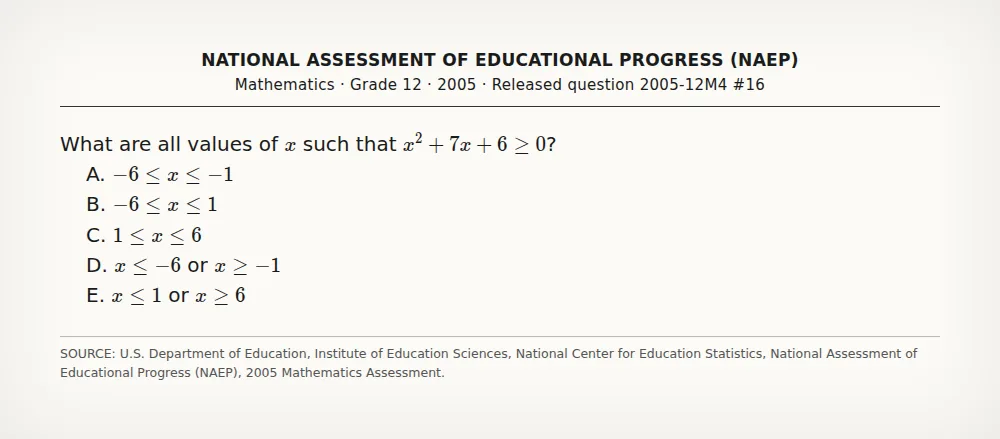
Question uploaded to PhotoExamAI: quadratic inequality (NAEP 2005 Mathematics, grade 12, question 2005-12M4 #16)

Question: What are all values of x such that x² + 7x + 6 ≥ 0? A. −6 ≤ x ≤ −1 B. −6 ≤ x ≤ 1 C. 1 ≤ x ≤ 6 D. x ≤ −6 or x ≥ −1 E. x ≤ 1 or x ≥ 6 Official question (NAEP Questions Tool)

x2+7x+6=(x+1)(x+6)0    x6 or x1(choice D)x^2+7x+6=(x+1)(x+6)\ge 0 \iff x\le -6\ \text{or}\ x\ge -1\quad \text{(choice D)}

Our check: Correct: it matches the official NAEP answer key (D). One sentence of the explanation is wrong, though (see “Where it gets it wrong”), and the photo could not be read, so we typed the question with the image attached. Nationally, 30% of 12th graders chose D in 2005. Response time: 52 s.

Full PhotoExamAI answer (unedited)

We want all real values of xx such that

x2+7x+60.x^2 + 7x + 6 \ge 0.

This is a quadratic inequality, so the standard method is:

  1. Factor the quadratic.
  2. Find its zeros.
  3. Use the sign of the quadratic on each interval determined by those zeros.

1. Factor the quadratic

We look for two numbers whose product is 66 and whose sum is 77.
Those numbers are 11 and 66, because 16=61 \cdot 6 = 6 and 1+6=71 + 6 = 7.

So we can factor:

x2+7x+6=(x+1)(x+6).x^2 + 7x + 6 = (x + 1)(x + 6).

Thus our inequality becomes

(x+1)(x+6)0.(x + 1)(x + 6) \ge 0.


2. Find the zeros (where it equals 0)

Set the expression equal to zero:

(x+1)(x+6)=0.(x + 1)(x + 6) = 0.

This happens when either factor is zero:

  • x+1=0x=1,x + 1 = 0 \Rightarrow x = -1,
  • x+6=0x=6.x + 6 = 0 \Rightarrow x = -6.

So the quadratic is zero at x=6x = -6 and x=1x = -1.

These two points divide the real line into three intervals:

  1. (,6)(-\infty, -6)
  2. [6,1][-6, -1]
  3. (1,)(-1, \infty)

We will study the sign of (x+1)(x+6)(x + 1)(x + 6) on each interval.


3. Sign analysis of the product

Because the quadratic has positive leading coefficient (the coefficient of x2x^2 is 1>01 > 0), its graph is a parabola opening upwards. That means:

  • It is negative between its roots.
  • It is positive outside its roots.
  • It is zero exactly at the roots.

We can also confirm this with a sign chart.

Interval 1: x<6x < -6

Take a test value, for example x=7x = -7:

  • x+6=7+6=1<0,x + 6 = -7 + 6 = -1 < 0,
  • x+1=7+1=6<0.x + 1 = -7 + 1 = -6 < 0.

Both factors are negative, so their product is positive:

(x+1)(x+6)>0for x<6.(x + 1)(x + 6) > 0 \quad \text{for } x < -6.

Interval 2: 6<x<1-6 < x < -1

Take a test value, for example x=3x = -3:

  • x+6=3+6=3>0,x + 6 = -3 + 6 = 3 > 0,
  • x+1=3+1=2<0.x + 1 = -3 + 1 = -2 < 0.

One factor is positive and the other negative, so the product is negative:

(x+1)(x+6)<0for 6<x<1.(x + 1)(x + 6) < 0 \quad \text{for } -6 < x < -1.

Interval 3: x>1x > -1

Take a test value, for example x=0x = 0:

  • x+6=0+6=6>0,x + 6 = 0 + 6 = 6 > 0,
  • x+1=0+1=1>0.x + 1 = 0 + 1 = 1 > 0.

Both factors are positive, so the product is positive:

(x+1)(x+6)>0for x>1.(x + 1)(x + 6) > 0 \quad \text{for } x > -1.

At the roots

At x=6x = -6 and x=1x = -1, we have

(x+1)(x+6)=0.(x + 1)(x + 6) = 0.

Since our inequality is 0\ge 0, those points are included in the solution set.


4. Solution set

Putting all this together:

  • The expression is positive for x<6x < -6 and x>1x > -1.
  • The expression is zero at x=6x = -6 and x=1x = -1.
  • The expression is negative for 6<x<1-6 < x < -1.

Therefore the set of all real xx such that

x2+7x+60x^2 + 7x + 6 \ge 0

is

x6orx1.x \le -6 \quad \text{or} \quad x \ge -1.

In interval notation: (,6][1,).(-\infty, -6] \cup [-1, \infty).


5. Match with the answer choices

Now compare with the options:

  • A. 6x1-6 \le x \le -1 → Only the interval between the roots. That is where the expression is negative, except at the endpoints. So A is incorrect.
  • B. 6x1-6 \le x \le 1 → Includes points between 6-6 and 1-1, where the expression is negative, and misses all x>1x > 1 and x<6x < -6. Incorrect.
  • C. 1x61 \le x \le 6 → Only a small part of where the expression is positive; it excludes x6x \le -6 and 1x<1-1 \le x < 1 and x>6x > 6. Incorrect.
  • D. x6 or x1x \le -6 \text{ or } x \ge -1 → Exactly matches our solution set. This is correct.
  • E. x1 or x6x \le 1 \text{ or } x \ge 6 → Includes some values (like 00) where the expression is positive, but also includes values (like 3-3) where the expression is negative; and it misses values less than 6-6. Incorrect.

Correct answer: D. x6 or x1.x \le -6 \text{ or } x \ge -1.

Grade 12 · Exponential growth

NAEP 2009 Mathematics, grade 12, question 2009-12M7 #3

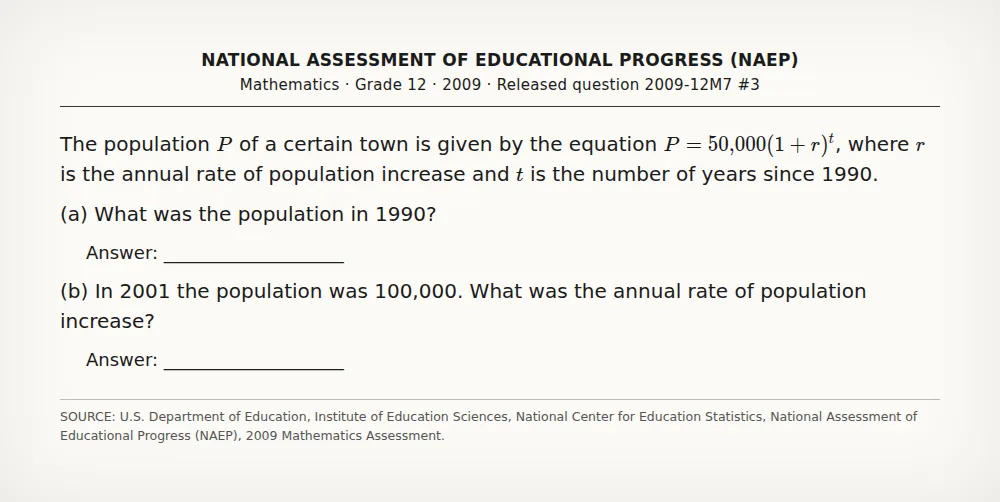
Question uploaded to PhotoExamAI: exponential growth (NAEP 2009 Mathematics, grade 12, question 2009-12M7 #3)

Question: The population P of a certain town is given by the equation P = 50,000(1 + r)^t, where r is the annual rate of population increase and t is the number of years since 1990. (a) What was the population in 1990? (b) In 2001 the population was 100,000. What was the annual rate of population increase? Official question (NAEP Questions Tool)

(a) P=50,000;(b) (1+r)11=2r=21/1110.065=6.5%\text{(a) } P = 50{,}000;\quad \text{(b) } (1+r)^{11} = 2 \Rightarrow r = 2^{1/11}-1 \approx 0.065 = 6.5\%

Our check: Correct. Same as the NAEP scoring guide (50,000 and 6.5%, with 6% to 7% accepted). In 2009 only 9% of 12th graders got both parts right; 46% got only part (a). Response time: 22 s.

Grade 12 · Depreciation (percent decrease)

NAEP 2005 Mathematics, grade 12, question 2005-12M12 #12

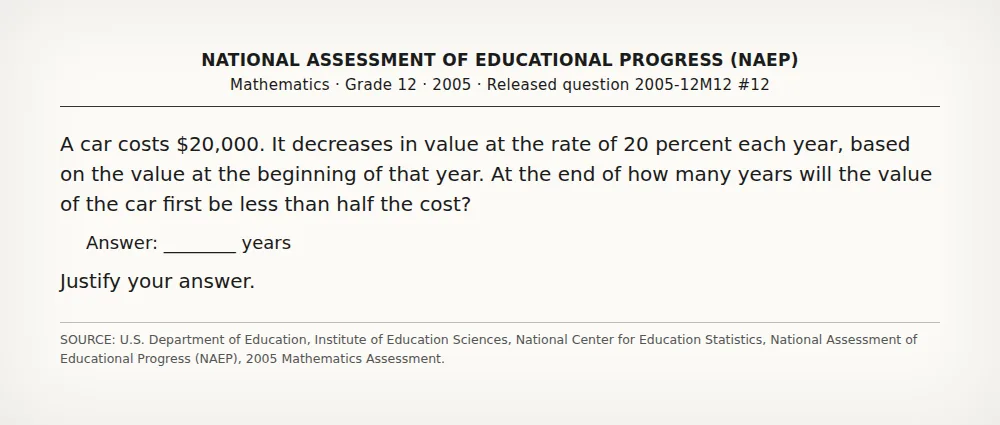
Question uploaded to PhotoExamAI: depreciation (percent decrease) (NAEP 2005 Mathematics, grade 12, question 2005-12M12 #12)

Question: A car costs $20,000. It decreases in value at the rate of 20 percent each year, based on the value at the beginning of that year. At the end of how many years will the value of the car first be less than half the cost? Justify your answer. Official question (NAEP Questions Tool)

20,0000.83=10,240,20,0000.84=8,192<10,000    4 years20{,}000 \cdot 0.8^{3} = 10{,}240,\quad 20{,}000 \cdot 0.8^{4} = 8{,}192 < 10{,}000 \;\Rightarrow\; 4\ \text{years}

Our check: Correct, with the same year-by-year table as the NAEP scoring guide. 26% of 12th graders gave a fully correct answer in 2005. Response time: 18 s.

Grade 12 · Sequences and patterns

NAEP 2005 Mathematics, grade 12, question 2005-12M3 #17

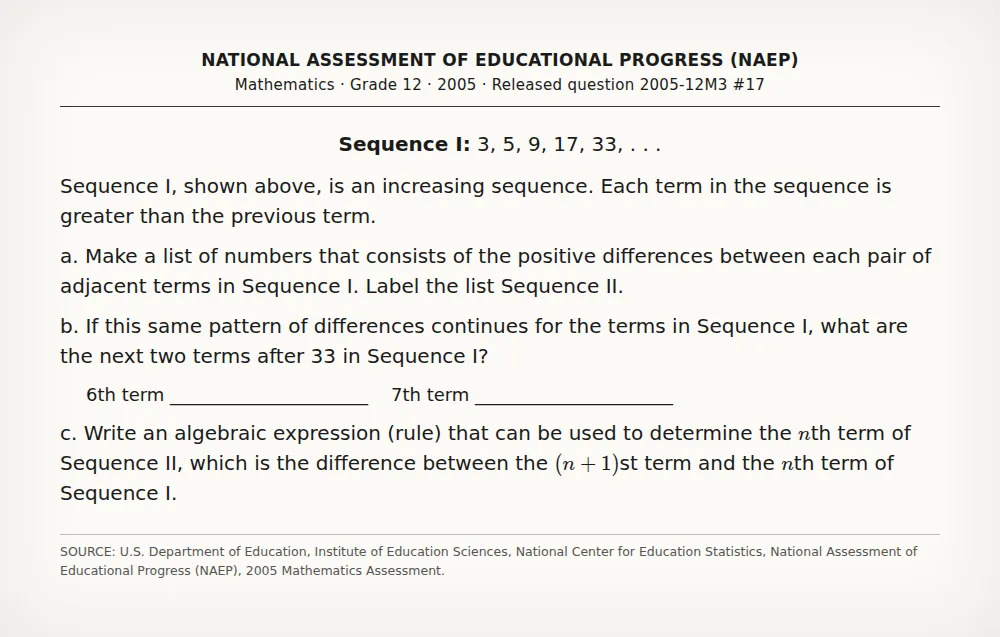
Question uploaded to PhotoExamAI: sequences and patterns (NAEP 2005 Mathematics, grade 12, question 2005-12M3 #17)

Question: Sequence I: 3, 5, 9, 17, 33, . . . a. Make a list of the positive differences between each pair of adjacent terms (Sequence II). b. If the same pattern of differences continues, what are the 6th and 7th terms of Sequence I? c. Write an algebraic expression (rule) for the nth term of Sequence II. Official question (NAEP Questions Tool)

II: 2, 4, 8, 16;a6=65, a7=129;an+1an=2n\text{II: } 2,\ 4,\ 8,\ 16;\quad a_6 = 65,\ a_7 = 129;\quad a_{n+1}-a_n = 2^{n}

Our check: Correct on all three parts, as in the scoring guide. This was the hardest one for students: in 2005 only 2% of 12th graders earned full credit and 47% partial credit. Response time: 35 s.

Grade 12 · Normal distribution (with a graph)

NAEP 2005 Mathematics, grade 12, question 2005-12M12 #16

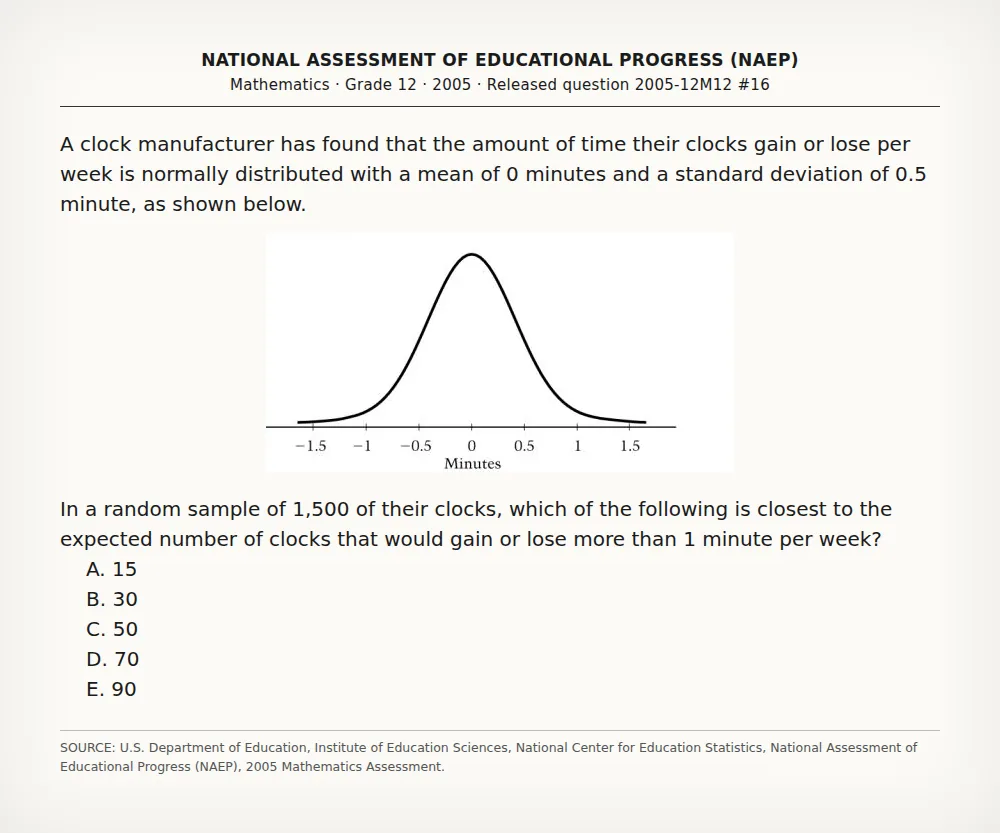
Question uploaded to PhotoExamAI: normal distribution (with a graph) (NAEP 2005 Mathematics, grade 12, question 2005-12M12 #16)

Question: A clock manufacturer has found that the amount of time their clocks gain or lose per week is normally distributed with a mean of 0 minutes and a standard deviation of 0.5 minute. In a random sample of 1,500 of their clocks, which of the following is closest to the expected number of clocks that would gain or lose more than 1 minute per week? A. 15 B. 30 C. 50 D. 70 E. 90 Official question (NAEP Questions Tool)

P(X>1)=P(Z>2)0.0455;1,5000.045568    D (70)P(|X|>1) = P(|Z|>2) \approx 0.0455;\quad 1{,}500 \cdot 0.0455 \approx 68 \;\Rightarrow\; \text{D (70)}

Our check: Correct (answer key D). It read the bell curve from the image and used the tails beyond 2 standard deviations. We got 0.0455 and 68.3 with SymPy. Only 12% of 12th graders chose D in 2005. Response time: 21 s.

SOURCE: U.S. Department of Education, Institute of Education Sciences, National Center for Education Statistics, National Assessment of Educational Progress (NAEP), 2005 and 2009 Mathematics Assessments.

Where it gets it wrong (what we saw in testing)

  • Reading the photo failed on two of our ten images. On the quadratic inequality above (and on one of the Italian exam questions we also tried) the text reader got stuck on the line under the exam header and kept writing underscores, more than 77,000 of them, until the connection dropped. It happened on every retry (six times on this question). The app then shows an error in the detected text box instead of the question. What worked: typing the question in that box with the photo still attached. If it happens to you, do the same.
  • A wrong sentence inside a right answer. On the quadratic inequality the final choice (D) is correct, but when it explains why E is wrong it says E “misses values less than −6”. It does not: E (x ≤ 1 or x ≥ 6) includes every x below −6. Read the reasoning, not only the last line.
  • Long answers. It explains every step, so these answers ran from about 1,500 to 3,600 characters. If you only want to check the result, choose “Result only” in the advanced options.
  • It is not infallible. The final result was right on all ten questions we tried (the five above and five from the Italian state exam), but ten tests prove nothing. If the result does not add up, check it with the derivative calculator, the integral calculator or the equation solver, or ask your teacher.

Frequently asked questions

What math problems can it solve?

High school and college math: equations and systems, inequalities, functions, exponential growth, sequences, probability and statistics, geometry, trigonometry, derivatives, integrals and word problems. On this page you have five released NAEP grade 12 questions solved with the tool as it is.

Can I solve a math problem from a photo?

Yes. Take the photo straight and well lit. The tool reads the text (formulas and graphs too), lets you fix it before solving and then explains the problem step by step. If the detected text comes back wrong or as an error, type the problem in the box.

How long does it take?

In our tests on September 23, 2026, between 18 seconds (the car depreciation question) and 52 seconds (the quadratic inequality). The answer appears while it is being written.

Does it answer in English?

Yes. In our tests every answer came back in the language of the question: the five NAEP questions in English and the five Italian exam questions in Italian.

Can I trust the answer?

It got the final result right on all ten questions we tried for this page (five from NAEP and five from the Italian state exam), but one explanation had a wrong sentence and no AI is infallible. Check the steps, especially when the problem has a figure or the photo is hard to read. To double-check a derivative, an integral or an equation, use the free calculators linked below.

More math tools